
Why So Many Unhappy Workers Are Staying Put

Updated: May 4
Workers across industries are burned out, disengaged, and quietly unhappy with their jobs. But they're not leaving. In fact, they're holding on tighter than ever. Not out of loyalty, but out of fear.
Welcome to the era of the Great Stay.
The Job Market Isn't What It Was
Not long ago, back in 2021 and 2022, the labor market belonged to workers. People were resigning freely, chasing better pay and flexible arrangements, and landing new roles with relative ease. Employers scrambled to fill seats.
That window has closed.
Today, hiring rates are near decade-long lows. Voluntary resignations have stagnated. Job seekers who enter the market are often there for months before landing something, if they land something at all. The average job search is now taking closer to six months, and competition for open roles is stiffer than it's been since before the pandemic.
Employers, meanwhile, are playing it cautious. Economic uncertainty, shifting trade policies, and a growing wait-and-see mentality around automation have made companies reluctant to add headcount. Some are actively reducing it.
The result is a workforce that's unhappy but afraid to move. People who feel stuck and are quietly buckling under the weight of it. AI is Raising the Stakes (and the Stress) Layered on top of an already soft job market is something bigger: the rapid, visible rise of artificial intelligence in the workplace.
For many employees, AI isn't just a buzzword anymore. It's a daily source of anxiety. Will it make their role redundant? Are they upskilling fast enough? What does their career look like in five years if the tools keep evolving at this pace?
These aren't irrational fears. Entry-level roles in several white-collar fields have already started contracting, particularly in areas where AI can handle repetitive, structured tasks. Customer service, content production, data entry, financial processing — all have seen meaningful shifts in how work gets divided between humans and automation.
What makes this especially difficult for employees is what might be called the "second job" effect. Companies are increasingly expecting workers to adopt AI tools on top of their existing workloads, often with little training or guidance. Productivity expectations have risen sharply, but support hasn't kept pace.
The message, whether intended or not, often lands as: do more, faster, or someone else will.
Quiet Cracking: When Workers Stay But Check Out
In a healthier labor market, disengaged employees might scale back their effort, do the minimum required, and start quietly looking elsewhere. But when the job market outside looks worse than what's inside, that calculation changes.
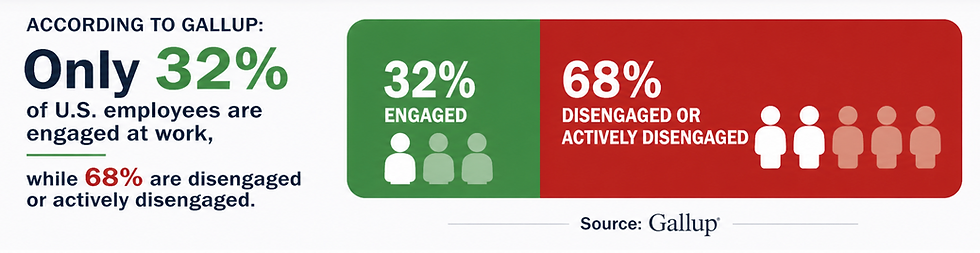
Instead of quitting, many workers are cracking gradually and persistently under pressure they feel they can't acknowledge or escape. Workplace researchers have started calling this "quiet cracking": a slow erosion of engagement, motivation, and well-being that doesn't look like a dramatic breakdown but builds steadily over time. The signs are real and measurable. Employee engagement in the U.S. has been declining for several years running, with more than two-thirds of workers describing themselves as either struggling or not fully engaged with their work. Burnout isn't an occasional challenge anymore. For a growing slice of the workforce, it's become the baseline.
And here's the irony: a workforce running on fumes isn't a competitive advantage for employers, even if it looks like one in the short term. Disengaged employees are less creative, less productive, and far more likely to leave the moment the market shifts in their favor. The leverage employers feel today could evaporate quickly once hiring picks back up. What's Driving This, and What Can Actually Help At its core, what we're seeing is a classic burnout equation. Demands have gone up, resources haven't, and the psychological safety net of a strong job market has been taken away.
For organizations looking to reverse this, a few things matter more than others.
Clarity around AI expectations. Workers who understand how and why AI is being used, and who have received actual training on the tools they're expected to use, are significantly less anxious about it. Ambiguity breeds fear. Transparency builds trust.
Honest conversations about workload. Piling more onto existing staff without acknowledging it isn't sustainable. Organizations that check in regularly on capacity and take the answers seriously tend to retain talent better, even in difficult markets.
Investment in career development. One of the biggest drivers of disengagement is feeling like a company isn't invested in your growth. When AI is framed as a tool to make employees more capable rather than a threat to their jobs, it changes the entire dynamic.
Recognition that this is a retention risk. The workers who are quietly cracking today are the first ones out the door when hiring rebounds. The cost of replacing experienced talent almost always exceeds the cost of supporting them now. What This Means If You're a Job Seeker If you're currently employed but unhappy, you're in good company, and it doesn't mean you have to stay put forever. The market is shifting. Tariff uncertainty is beginning to ease. Hiring in specialized fields, particularly in technology and cybersecurity, has remained more resilient than in other sectors.
If you're actively looking, the key is to stay visible and stay ready. Keep your skills current, be intentional about your network, and work with recruiters who actually know the market you're trying to enter.
At Rekruitd, we work specifically in IT and cybersecurity, two areas where demand for skilled professionals continues to outpace supply even in a cooler hiring environment. If you're ready to explore what's out there, we'd love to talk.
The Great Stay won't last forever. When the window opens, you'll want to be ready to move.
Looking for your next IT or cybersecurity role? Reach out to the team at Rekruitd. We specialize in connecting top-tier talent with the right opportunities.
